

Jaye Deighton, Global Head of ICT and Innovation, explores why visibility is the essential foundation for successful AI adoption
AI has quickly become one of the most talked-about topics in business. Across boardrooms, organisations are exploring how AI can improve efficiency, enhance decision-making, and create competitive advantage.
Yet before fully committing to AI, organisations should first consider two fundamental questions – do they truly understand their own operations, and do they truly understand the quality of their data? Put simply, are they visibility-enabled before attempting to become AI-enabled?
Visibility is the foundation that makes AI valuable. Without a clear understanding of operations and trusted information, even the most advanced AI tools will struggle to deliver meaningful results.
A personal example highlights the principle. For a period of time, I regularly visited a local supermarket and noticed they were frequently out of almond croissants, which may or may not be a personal favourite of mine. Whenever they did have them available, the self-service checkout offered no option to select an almond croissant. Staff would simply advise customers to process the item as a regular croissant because both products were priced the same. On the surface, it seemed like a minor issue. In reality, it created a significant blind spot.
Every time an almond croissant was recorded as a regular croissant, the supermarket lost valuable information about customer demand. Their systems consistently understated sales of almond croissants, leading to inaccurate ordering decisions and continued stock shortages. What appeared to be a supply issue was actually an information issue – a challenge many organisations encounter every day.
Operational workarounds, disconnected systems, duplicated records, spreadsheet-based processes, and critical information stored in email inboxes rather than central platforms all reduce visibility. Individually, these issues may seem insignificant. Collectively, they create an incomplete picture of what is really happening across a business.
This matters because information has value. If someone walked out of a business carrying a bag filled with cash every day, it would trigger immediate concern. Yet organisations often allow value to leak away through poor-quality data, fragmented processes, and limited visibility without fully appreciating the impact on performance and decision-making.
As businesses increasingly look to adopt AI, these challenges become even more important. AI is a powerful tool, but it cannot create certainty from unreliable information. In many ways, AI amplifies the environment in which it operates.
If data is incomplete or inconsistent, the outputs will reflect those weaknesses. If information is accurate, accessible, and trusted, AI can unlock significant efficiencies and insights.
The businesses that stand to benefit most from AI will not necessarily be those making the largest technology investments, but those with the clearest understanding of their operations and the greatest visibility across their activities.
This is particularly relevant in industries such as energy, where operational complexity continues to increase and decisions often need to be made quickly and with confidence. Visibility across assets, activities, and information flows is no longer simply an operational advantage; it is a strategic necessity.
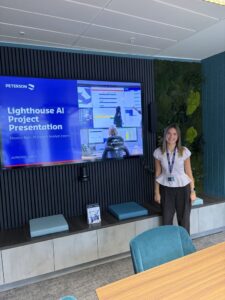
At Peterson Energies, we have not only invested capital in creating and managing a market-leading software solution, we have also invested significant time and energy throughout all levels of our organisation to understand how we align data and operations to create better and more effective working days, more efficient operations, and enhanced strategic and operational decision-making. Since 2012, our Lighthouse software suite has been developed alongside operational experts who use it every day and has supported the movement of more than 10 million tonnes of cargo. By bringing critical operational information together within a single platform, Lighthouse allows Peterson, and our customers, to gain greater visibility across complex supply chains, improve operational performance, and make decisions with greater confidence.
That is why digital transformation should be viewed as more than a technology initiative. At its heart, it is about creating visibility and ensuring organisations have a trusted, connected view of their operations, enabling them to identify trends earlier, improve coordination, strengthen resilience, and make better-informed decisions.
Before businesses can become AI-enabled, they must first become visibility-enabled. In an increasingly complex and data-driven world, the ability to access, trust, and act upon accurate information may prove to be one of the most important competitive advantages an organisation can possess.